
What ANSI Standards Mean for Your Next Project With A Fire Pit
A practical guide for architects and designers specifying decorative concrete fire features.
When you design with fire, you design with responsibility. The last thing you want is a permit delay, a failed inspection or a callback six months later. Compliance isn’t paperwork. It’s protection for your design, your client and your reputation.
You need to match beauty and craftsmanship with rigorous safety and performance standards. And that’s why you need to understand ANSI fire pit standards.
At DreamCast, our fire features are ETL certified through Intertek Laboratories and tested to ANSI Z21.97 / CSA 2.41 standards, ensuring safety, performance, and smoother approvals across North America.

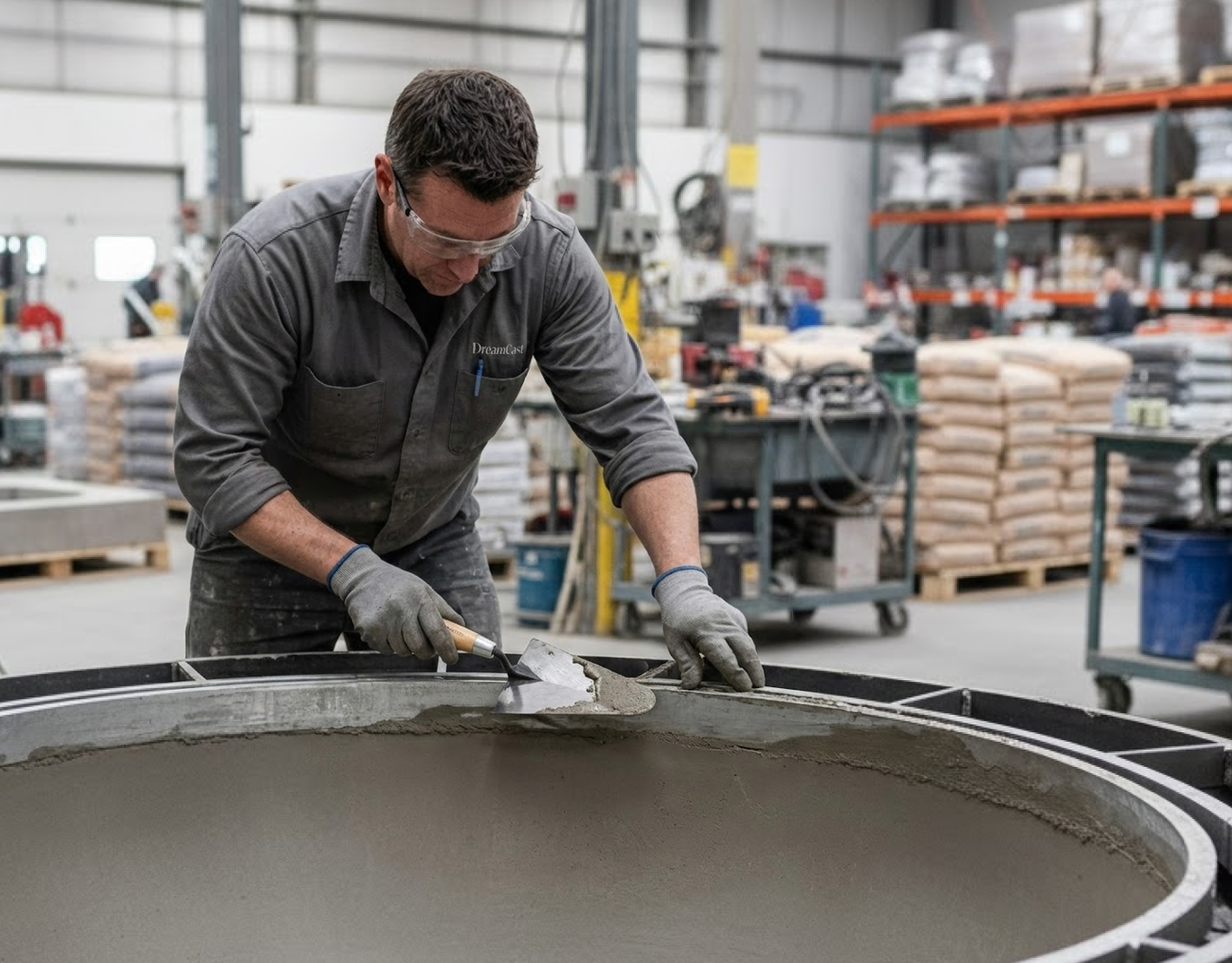
What Are ANSI Fire Pit Standards?
The American National Standards Institute (ANSI) ensures that industry standards, developed by groups like CSA and ASTM, are rigorously vetted and consensus-based. For outdoor gas fire features, the primary standard is ANSI Z21.97/CSA 2.41, which governs everything from burner safety to fuel systems. It applies to portable, built-in, and stationary gas appliances used outdoors.
For outdoor gas fire features, the governing standard is: ANSI Z21.97 / CSA 2.41- Outdoor Decorative Gas Appliances
This standard regulates:
- Burner construction and flame stability
- Ignition systems
- Gas pressure limits
- Leak detection and shut-off mechanisms
- Wind and rain performance testing
- Clearance requirements
In practical terms? It means the fire feature has been third-party tested to operate safely in real-world outdoor conditions.
What ANSI Z21.97 / CSA 2.41 Covers
- WIND PERFORMANCE
Burners must ignite and operate in sustained 10 mph winds and remain stable or safely extinguish in gusts up to 31 mph.
Why this matters:
Rooftop terraces, coastal properties, and open landscapes demand flame stability. Poor wind performance results in nuisance shutdowns, or worse, unsafe operation.
- RAIN TESTING
Units must withstand simulated storm exposure and resume normal function afterward.
Why this matters:
Outdoor features are rarely protected. Drainage, ignition protection, and material integrity must perform after exposure.
- CLEARANCE REQUIREMENTS
Typically: ~24 inches lateral clearance from combustibles, ~72 inches overhead clearance
Learn more about clearance and layout for outdoor gas fire pits.
Why this matters:
Built-in millwork, pergolas, soffits, and overhangs must account for these zones during planning, not after framing.
- FUEL SYSTEM SAFETY
Standards regulate: Gas pressure limits, Cylinder sizing, Flame supervision devices, Automatic shut-off systems
- FUEL SYSTEM SAFETY
These components reduce gas leak risks and uncontrolled flame behavior.
For trade professionals, these requirements are vital to ensure installations pass municipal inspections and operate safely.
Beyond the Standard: How DreamCast Goes a Step Further
DreamCast fire products go beyond standard compliance. Each unit is designed for real-world site conditions, integrating performance-tested burners and precision-crafted concrete structures.
Built to withstand everything from alpine cold to coastal heat.
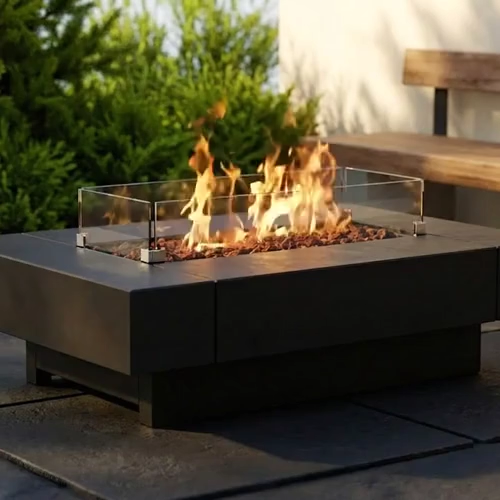
Reinforced Concrete: Built for Fire, Weather and Time
DreamCast fire features and mantels are made with GFRC (Glass Fiber Reinforced Concrete), a material uniquely suited to the demands of outdoor and high-heat environments. Additionally, our concrete mix includes pozzolans like fly ash. It’s an industrial waste byproduct that improves strength while reducing environmental impact.
Unlike traditional concrete, which is strong in compression but brittle under tension, GFRC is formulated with AR (Alkali-Resistant) glass fibers that provide flexural strength. This allows the concrete to expand and contract with thermal changes, especially important in fireplaces and fire pits that experience direct flame exposure.
It’s also highly beneficial in cold climates like mountain resorts, where outdoor fire features need to survive freeze-thaw cycles. Because AR glass fibers won’t rust, they offer long-term stability in concrete’s naturally high-alkaline environment. The result is a product that’s not only beautiful, but engineered to last.
It’s also highly beneficial in cold climates like mountain resorts, where outdoor fire features need to survive freeze thaw cycles. Because AR glass fibers won’t rust.
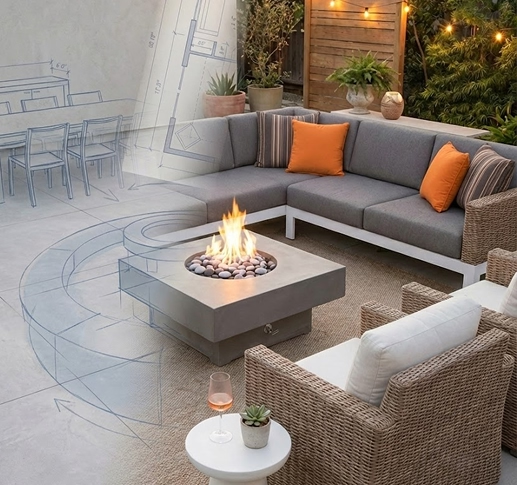
How This Impacts Your Drawings & Specifications
When you specify an ANSI-certified fire feature, you simplify:
- Permit submission documentation
- Gas line coordination
- Combustible adjacency planning
- Inspection approvals
So your team isn’t chasing compliance mid-build.
ANSI, CSA, ETL, UL & CE: What do these labels mean?
ANSI Z21.97 / CSA 2.41 – This is the North American performance standard for outdoor decorative gas appliances.
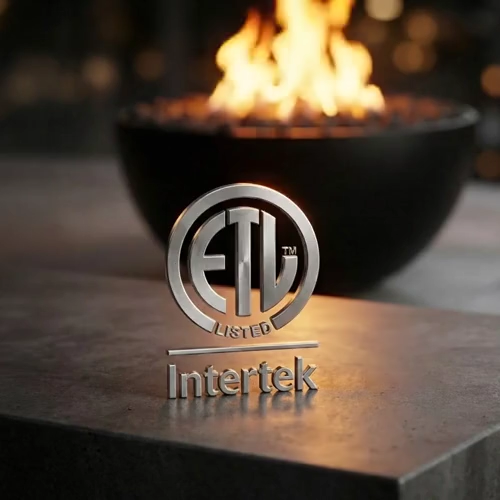
ETL Listed (Intertek Laboratories) – DreamCast fire features are ETL Listed, meaning Intertek, a Nationally Recognized Testing Laboratory (NRTL), has independently tested our burner systems to meet ANSI standards.
CSA Group – CSA is another NRTL that tests to the same ANSI/CSA standards. They are a certification body, not the standard itself.
UL / ULC – UL is also an NRTL and may test products to ANSI standards depending on the appliance type.
CE Marking – Applies to European compliance and is not used for North American gas fire pit approvals.
For permitting across the U.S. and Canada, ETL Listing through Intertek confirms compliance with the ANSI standard and is widely accepted by AHJs (Authorities Having Jurisdiction).
Ready to design with confidence?
When you choose DreamCast, you receive:
- Burner systems ETL Listed through Intertek
- Compliance with ANSI Z21.97 / CSA 2.41 standards
- Engineered GFRC construction
- Clearance and venting documentation
- Permit-ready certification packages

Clear documentation. Recognized testing. Smooth approvals.
At DreamCast, quality shows up in every detail, from the materials we use to the way we guide you through the process. Our fire pits and mantels are built to perform, designed to inspire and supported by a team that’s here whenever you need us.
Quality. Durability. Service. In That Order.
QUALITY
We use burner systems that are ETL Listed through Intertek Laboratories and tested to ANSI Z21.97 / CSA 2.41 standards. Every ignition system, gas control component, and flame performance element has been independently evaluated under real-world outdoor conditions.
This gives you third-party verification, not just manufacturer claims.
DURABILITY
Our corrosion-resistant, rust-proof burners are backed by a lifetime warranty. Our GFRC bodies resist flaking, fading, and cracking, even in demanding climates.
SERVICE
From certification packages to CAD files and sample kits, we support your project before, during, and after installation. If questions arise, you won’t navigate them alone.

Get In Touch
Still have questions about fire bowls or fire tables? Give us a call at 1-888-337-0597, and one of our team will be happy to help!
If you’re not ready to make any decisions right now, why not take a look at our product gallery for more inspiration, or follow us on Instagram to keep up with the latest trends and promotions.
FAQs
How much clearance does a fire pit need?
ANSI Z21.97 / CSA 2.41 typically requires at least 24 inches of lateral clearance and overhead from combustible materials depends on the burner system. Always confirm with local code authorities and manufacturer documentation.
What is the best material for a fire pit area?
Non-combustible surfaces such as concrete, stone, or pavers rated for high heat exposure are recommended. The surrounding zone should resist heat transfer and prevent ignition risks. Certain manufacturers like DreamCast allow fire pits to be placed directly on decks.
What type of concrete should be used for a fire pit?
Glass Fiber Reinforced Concrete (GFRC) is ideal due to its flexural strength and resistance to thermal stress, making it better suited for flame exposure than traditional cast concrete. At DreamCast, our concrete mix includes pozzolans like fly ash. It’s an industrial waste byproduct that improves strength while reducing environmental impact.
Will concrete crack in a fire pit?
Standard concrete can crack under repeated thermal expansion. GFRC significantly reduces this risk because its fiber reinforcement improves tensile performance and thermal tolerance. At DreamCast Design we combine decades of fire feature experience to our product design to enable the materials long-term performance.
Is 50,000 BTU enough for a fire pit?
For residential patios, 50,000 BTU is typically sufficient for warmth and visual flame presence. Larger commercial or open-wind environments may require 65,000–100,000+ BTU systems, depending on exposure and seating distance. DreamCast offers high BTU fire bowls and fire tables that sit above 100,000 BTU, promising real warmth without sacrificing visual harmony. Learn more about how to choose the right high BTU outdoor gas fire pit.
As a partner at DreamCast, she has been immersed in the decorative concrete industry since 2007, specializing in fire pits & mantels. With a passion for interior design her expertise drives innovative design and exceptional craftsmanship.


Author
Catherine Traschenko
Fire Products
Design Specialist
Author
Catherine Traschenko
Fire Products
Design Specialist